When a printed barcode looks faded, scratches easily, or becomes difficult to scan, many users immediately assume that the printer is the problem. However, print quality is not determined only by the condition of the printhead or the specifications of the device. One component that has a major impact on the final result is the barcode printer ribbon.
A ribbon acts as the ink carrier in the thermal transfer printing process. When the printhead applies heat, the ink coating on the ribbon is transferred to the label surface, creating text, barcodes, graphics, or other information. However, not every ribbon has the same characteristics. Some are wax-based and designed for cost-efficient paper labels, while others use wax-resin or resin formulations to provide greater durability.
Choosing the wrong ribbon can create several operational problems. A label may look clear immediately after printing but begin to fade after repeated handling. Barcode quality may decline because the ink does not adhere properly to the label material. In more demanding environments, labels may be damaged by abrasion, chemicals, heat, moisture, or prolonged exposure to external conditions.
For this reason, choosing a ribbon should not be based on price alone. The label material, operating environment, required durability, and printer compatibility all need to be considered together. With the right combination, barcodes can remain clear, scannable, and durable throughout their intended lifespan.
Understanding the Role of a Barcode Printer Ribbon
A barcode printer ribbon is a thin film coated with an ink formulation made primarily from wax, resin, or a combination of both. During thermal transfer printing, heat from the printhead transfers the ink coating from the ribbon onto the label surface. This process can produce more durable printed labels than many direct thermal applications.
In simple terms, the ribbon acts as the connection between the printer’s thermal energy and the label material. However, printing performance does not depend on the ribbon alone. The type of label also affects how well the ink adheres and how long the printed information remains readable.
For example, standard paper labels have different surface characteristics from synthetic materials such as polypropylene or polyester. A wax ribbon that performs well on a paper label may not provide the same level of durability on a synthetic label. On the other hand, a high-performance resin ribbon may be unnecessary when a label is used only temporarily in a clean indoor environment.
This is why ribbon selection should be viewed as part of a complete printing system. The printer, ribbon, and label material must be compatible with one another.
The Difference Between Wax, Wax-Resin, and Resin Ribbons
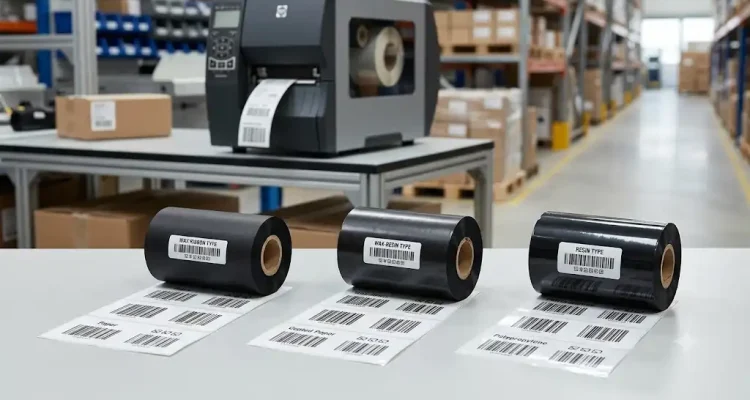
The three most common types of barcode printer ribbons are wax, wax-resin, and resin. Their main differences are related to ink composition, print durability, material compatibility, and intended applications.
No single ribbon type is best for every situation. Each formulation is designed to meet different operational requirements.
Wax Ribbon: A Cost-Effective Choice for Paper Labels
Wax ribbons use an ink formulation that is primarily wax-based. They are generally considered an economical option for everyday label printing, especially when used with paper-based materials.
Wax ribbons are commonly used for:
- product labels;
- price labels;
- inventory labels;
- shipping labels;
- carton labels;
- warehouse labels used in normal indoor conditions.
One of the main advantages of wax ribbons is their ability to produce good print quality at relatively high printing speeds. They are widely used for standard paper-label applications where extreme durability is not required.
However, wax ribbons generally offer lower resistance to abrasion, chemicals, and demanding environmental conditions than wax-resin or resin ribbons. If a label is frequently handled, exposed to moisture, or used in a harsh environment, wax-based printing may wear down more quickly.
Wax ribbon is a practical choice when a business needs cost-efficient printing and the label does not need to withstand extreme conditions.
Wax-Resin Ribbon: A Balance Between Cost and Durability
Wax-resin ribbons combine the characteristics of wax and resin. This formulation generally provides greater durability than a standard wax ribbon while remaining more cost-effective and flexible than a full-resin option.
Wax-resin ribbons are often used when labels need better resistance to:
- friction;
- scratches;
- smudging;
- moderate moisture;
- light to moderate chemical exposure.
They can be used with a range of label materials, including coated paper and certain synthetic labels with compatible surfaces. This makes wax-resin ribbons suitable for many retail, manufacturing, warehouse, and product-labeling applications.
For example, a company may use labels to identify components that move through several stages of a production process. These labels may experience repeated handling and friction during storage and transportation. In this situation, a standard wax ribbon may not provide enough durability, while a full-resin ribbon may be more than necessary. A wax-resin ribbon can offer a more balanced solution.
However, durability still depends on the specific ribbon and label combination. Not all wax-resin ribbons use the same formulation, so testing under actual operating conditions remains important.
Resin Ribbon: High Durability for Demanding Environments
Resin ribbons contain a higher percentage of resin and are designed to produce highly durable printed results. Compared with wax and wax-resin ribbons, resin ribbons generally offer stronger resistance to abrasion, chemicals, heat, and demanding environmental conditions.
Resin ribbons are commonly used with synthetic label materials such as polyester, polypropylene, and other specialized substrates. Typical applications include:
- asset labels;
- electronic component labels;
- chemical product labels;
- industrial labels;
- outdoor identification labels;
- long-life tracking labels.
Resin ribbons are often selected when labels must remain readable despite exposure to challenging conditions. However, resin is not automatically the best choice simply because it provides the highest level of durability.
Resin ribbons may have a higher cost and can require appropriate printer settings to achieve the intended print quality. If a label is used only for short-term shipping or temporary inventory identification, the additional durability of a resin ribbon may provide little practical value.
The best ribbon is therefore not always the most durable one. It is the ribbon that provides the required performance for the actual application.
When Should You Use a Ribbon Instead of Direct Thermal?
One common misunderstanding is that every thermal printer requires a ribbon. In reality, there are two main thermal label-printing methods: thermal transfer and direct thermal.
Thermal transfer printing uses a ribbon. Heat from the printhead transfers the ink coating from the ribbon onto the label material. This method is generally chosen when businesses need longer-lasting labels or greater resistance to handling and environmental conditions.
Direct thermal printing does not use a ribbon. Direct thermal labels have a heat-sensitive coating that changes color when heat is applied by the printhead. The technology is similar to the printing method used for many thermal receipts.
Direct thermal can be an efficient choice for short-term applications such as:
- shipping labels;
- courier labels;
- tickets;
- queue labels;
- ready-to-serve food labels;
- labels used during short distribution processes.
Because no ribbon is required, the printing process can be simpler and there is no ribbon to replace. However, direct thermal labels can be more sensitive to heat, light, friction, and certain storage conditions. For long-term identification or more demanding environments, thermal transfer printing often provides greater flexibility and durability.
The key difference is simple: thermal transfer media requires a ribbon, while direct thermal media does not.
Choosing a Ribbon Based on Label Material
Selecting a barcode printer ribbon cannot be separated from the type of label material being used. The right combination can produce sharp, durable printing. The wrong combination may cause poor ink adhesion, reduced scratch resistance, or inconsistent barcode readability.
Paper Labels
For standard paper labels, wax ribbon is often a cost-effective option. It is suitable for applications that do not require extreme durability, such as price labels, product labels, or indoor inventory labels.
If the paper label has a special coating and requires better resistance to handling, a wax-resin ribbon may be worth considering. However, the material specifications should still be checked because paper surfaces can vary significantly.
Coated Paper Labels
Coated paper labels have a smoother surface than uncoated paper. In some applications, wax-resin ribbons can provide better resistance to smudging and abrasion.
This combination may be useful when labels need to remain readable throughout longer storage or distribution processes.
Synthetic Labels
Synthetic materials such as polypropylene and polyester are commonly used when labels need stronger resistance to moisture, chemicals, temperature changes, or demanding environmental conditions.
For these applications, resin ribbon is often a more suitable choice. However, compatibility should still be tested because synthetic materials, surface coatings, and ribbon formulations can vary.
The ribbon and label should be selected as a matched combination rather than as separate components.
Do Not Overlook Ribbon Size and Coating Direction
In addition to choosing between wax, wax-resin, and resin formulations, users also need to consider the physical dimensions of the ribbon.
The ribbon should generally be the same width as, or slightly wider than, the label media. If the ribbon is too narrow, parts of the printhead may not be protected during printing. Over time, this may contribute to uneven printhead wear.
Ribbon length should also match the printer’s capacity and the business’s printing volume. A longer ribbon may reduce the frequency of replacement in high-volume operations, but the printer must support the selected roll size.
Another important detail is the ribbon’s ink coating direction. Some printers require ribbons with the ink coating on the outside, while other printer designs may use a different configuration. If the coating direction is incompatible with the printer, printing may fail even when the ribbon type and label material are otherwise correct.
Before purchasing, check the printer specifications for:
- minimum and maximum ribbon width;
- supported ribbon length;
- ribbon core size;
- ink coating direction;
- recommended ribbon formulations.
How to Choose the Right Ribbon for Your Business
Before selecting a barcode printer ribbon, businesses should consider the following questions:
How long does the label need to remain readable?
If the label will be used for only a few days, direct thermal or wax ribbon may be sufficient. If it must remain readable for months or years, thermal transfer printing with a more durable ribbon may be more appropriate.
What label material is being used?
Paper, coated paper, and synthetic labels require different approaches. The ribbon should be compatible with the surface of the selected material.
Will the label experience frequent friction or handling?
If the label is likely to be scratched or rubbed regularly, wax-resin or resin may provide better durability than standard wax.
Will the label be exposed to chemicals, moisture, or high temperatures?
Demanding environments may require both a durable label material and a high-performance ribbon.
How many labels are printed each day?
High print volumes may affect the ideal ribbon length, printing speed, replacement schedule, and overall operating cost.
How will the barcode be scanned?
Labels used in warehouses, manufacturing facilities, or outdoor environments should be tested with the actual scanners and operating conditions used by the business.
Real-world testing remains an important part of the selection process. Product specifications can provide useful guidance, but the best combination can only be confirmed after the printer, ribbon, and label have been tested in the intended application.
Common Mistakes When Choosing a Barcode Printer Ribbon
Several common mistakes can reduce print quality and increase operating costs.
Choosing a ribbon based only on price.
A low-cost ribbon may not provide the lowest overall cost if labels wear out quickly and need to be printed again.
Using a ribbon that is incompatible with the label material.
The wrong combination can result in poor ink adhesion, fading, or reduced durability.
Using resin ribbon for every application.
Resin provides high durability, but it may be unnecessary for simple, short-term labels.
Ignoring ribbon width.
A ribbon that is too narrow may leave parts of the printhead unprotected during printing.
Overlooking printer settings.
Print speed and darkness settings should be adjusted to produce sharp output without making barcode elements too wide or excessively dark.
Skipping durability tests.
A label may look good immediately after printing but fail when exposed to friction, moisture, heat, or chemicals.
Conclusion
Choosing the right barcode printer ribbon is not simply a matter of selecting wax, wax-resin, or resin. The decision should consider the label material, operating environment, required durability, print volume, and printer compatibility.
Wax ribbon is suitable for cost-efficient paper-label applications under normal conditions. Wax-resin provides a balance between cost and durability, especially when labels require better resistance to handling and abrasion. Resin is designed for demanding applications that require high durability and are commonly used with synthetic label materials.
Businesses should also understand the difference between thermal transfer and direct thermal printing. Ribbon is used only in thermal transfer printing, while direct thermal printing uses heat-sensitive media and does not require a ribbon.
Ultimately, the best barcode printer ribbon is not always the most expensive or the most durable option. It is the ribbon that produces clear print, reliable barcode readability, and the level of durability required by the application. By selecting the printer, ribbon, and label as a compatible system, businesses can improve label quality while reducing reprints, operational disruptions, and unnecessary costs.